| Henry Finmore | |
|
Memorabilia
|
And an extract from "Seven Years at Eton" written by James Brinsley-Richards of the years 1857 to 1864. Old Finmore had been servant to Dr Hawtrey when the latter was headmaster. He was a shambling old fellow, whose face was covered with eruptions like grog-blossoms, though they were not evidences of any want of sobriety on his part. He was door-keeper to the headmaster’s chambers, but he held the still more responsible office of rod-maker, for which he was paid a fixed salary. It was his business to see that there were always at least half-a-dozen new rods in the cupboard of the “library” (for a rod was seldom used twice); and Dr Goodford was apt to get very angry if an execution had to be adjourned for want of larches…
Henry Finmore was born at Bray, Berkshire on 19 July 1800 and married Mary Sidwell at Stanwell, Middlesex on 6 August, 1833. They had a daughter, Sarah, who was born in 1843 at Eton. Henry's father's will, witnessed by three Eton masters, was written in July 1829 which may suggest that he was already employed at Eton by that time. Or did masters with law qualifications earn extra money by drawing up wills for local people? In 1838 he was a witness when Edward Craven Hawtrey appointed Thomas Batchelor his attorney in connection with the Tithe Commutation Act so it seems very likely he was the headmaster's servant by that time. Most of the references to "Finmore" in the two books of reminiscences seem to feature his rod-making role, which obviously left a lasting impression on Eton boys, but other duties are mentioned. From the "Forties" it appears that Henry accompanied the headmaster around the school: It was comical to see Hawtrey patrolling Long Chamber of an evening, preceded by Finmore, his servant, carrying a lantern in his hand. Master and servant walked, apparently in blissful unconsciousness, through the half-prepared scenery of “A Midsummer Night's Dream” and “High Life Below Stairs.” When the school is summoned because three local ducks have been injured by fourth-form boys armed with slings, Hawtrey reportedly ends his address with: "This is no laffing matter. Finmore, shut that door!" No doubt Henry was less than amused by incidents such as the one described next, which was far from unique according to both books. Do you know the story of Thring (captain of school) tying a string around the handle of the bell, just behind Hawtrey, and passing the string under Hawtrey's chair to little Henry Coleridge on the other side? First pull, up came Finmore. "Did you ring, sir?" "No." Second pull. Ditto. Much pressure and pinching to make Coleridge pull it a third time, but he did so. Again Finmore, asserting that it had been rung three times. Hawtrey looked about him, and caught sight of the peccant string. "Thring, did you ring the bell?" "No, sir, I didn't ring it." "Thring, I'm ashamed of you - contemptible subterfuge." An article in the Bath Chronicle and Weekly Gazette dated Thursday 13 July 1843 reveals that Henry's duties included health and safety issues beyond what you might expect of a butler. The Long Chamber at Eton College - A few mornings since, at the early hour of two o’clock, the greatest alarm was created amongst the pupils on the foundation, who were awakened by a loud crashing noise, proceeding from the roof of the Long Chamber, which is the sleeping apartment of the foundation scholars, and of which there were then in the room between forty and fifty. As the noise continued to increase, and some portions of the mortar from the ceiling came tumbling down in various parts of the chamber, the boys, who are invariably locked in upon retiring to rest, had no other means of making known their hazardous situation than by ringing the alarm bell, which speedily brought a person named Finmore (in the establishment of the Rev. Dr. Hawtrey, the head master) to their rescue. So fifty boys were locked in throughout the night and depended on the butler to release them in an emergency. How attitudes have changed over the years. The article explains what had happened. Early that morning workmen were employed in examining into the stability of the roof, which is covered with lead, weighing upwards of thirty tons. The king post and rafters were found to be in a pretty sound state; but the principals, which are the large beams extending crosswise from wall to wall, and by which the heavy roof is entirely supported, were discovered to be in a state of extreme rottenness and decay at the ends, which rested on the exterior walls, and that some portions of them had given way. "Strong upright pieces of timber, of great thickness" were erected along the centre of the room, "and all further alarm of danger is at an end." It seems the boys continued to sleep there for three weeks until the vacation when "this portion of the ancient edifice will undergo a thorough repair". The author of "Seven Years at Eton" concentrates on the birch making duties performed by "Finmore" and includes a colourful description of the pitfalls of his work. Finmore used to make the rods at his own house, with the assistance of a tender and devoted wife; and he brought them to the library clandestinely after lock-up, or in the morning before early school. To be quite on the safe side, Finmore ought to have arranged that there should be a dozen new rods in the cupboard every morning, for there was no calculating the number of floggings that might be inflicted in a day. Sometimes days passed without any boy being in the Bill; but there were other days when more than a dozen boys would come up for whipping, and the offences of some of them might require the use of two birches. If the supply of rods ran short, Finmore might have to bring in fresh ones in the middle of the day, when all the boys were about, and this was always a perilous undertaking. Once under Dr. Goodford six boys had to be flogged after three o'clock school; but there were only three birches available. The Doctor, who never liked to see his justice go ped claudo, flogged three of the culprits and adjourned the others till six o'clock; but he ordered the Sixth Form praepostor to be sure and tell Finmore that the cupboard must be replenished before six. The message was delivered; but some Lower boys hearing that Finmore was bound to come to the library with new rods between four and five, lay in wait for him. Presently the old boy was seen hovering near the top of Keate's Lane, empty handed, but walking suspiciously near to a grocer's cart. The cart made its way towards Weston's Yard, Finmore hobbling after it, and it became evident that the rod-maker had prayed the driver of the cart to give his contraband merchandise a lift. In a twinkling a shout was raised, and fifty boys scampered off to the end of the Long Walk. The cart was stopped as it turned into Weston's Yard; the boys surrounded it yelling, and extracted from it six new birches wrapped in a cloth. Thereupon Finmore, breathless and almost choking with emotion, made an appeal that his rods should not be destroyed. They were not destroyed, but half a dozen boys ran off with one a-piece, and Finmore was left moaning. "Oh, gentlemen, what a silly job this is! What's the use of getting me into trouble? The Doctor 'ill wallop you all the same, and you'll only get it all the hotter if you keep him waiting till to-morrow morning." Henry died at Eton early in 1874 aged 75. He would have been over sixty when the following was written about him because the Dr Balston mentioned did not become headmaster until 1862. Finmore used to make extra money by selling birches as mementoes to boys who were leaving. He was eventually relieved of his duties by Dr. Balston, because in extreme old age his hand lost its cunning, and he made birches which were so ill-tied that they fell to pieces when used. A compensation was paid him when a younger college servant was appointed lictor in his stead. In future I will look more closely at any birches I find hanging on the library walls of stately homes.
|
| Top of Page |  |
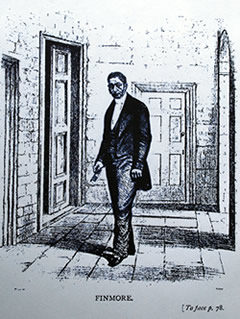 Portrait of Henry Finmore from the book "Eton in the Forties" by Arthur Duke Coleridge.